
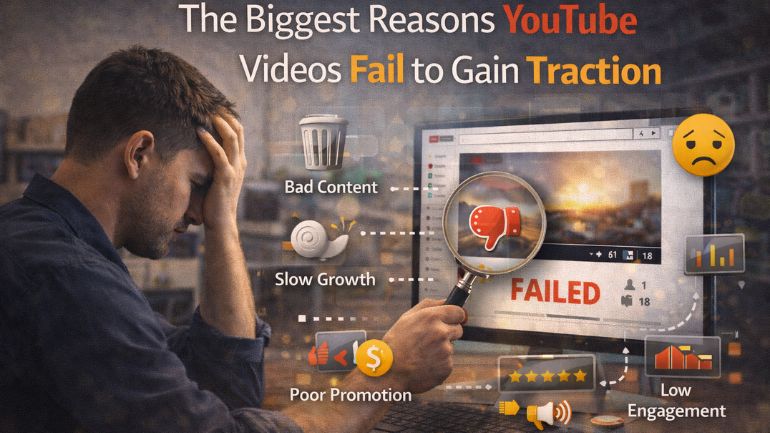
Let’s be honest there’s nothing quite as deflating as spending a weekend on a video, hitting publish, and then watching the view count sit at 47 for three days straight.
Most creators have been there. And the frustrating part? It’s usually not because the video was bad. Plenty of genuinely good content goes nowhere on YouTube, while stuff that took twenty minutes to film racks up hundreds of thousands of views. That gap isn’t random, but it also isn’t fair.
What it comes down to is a handful of specific things some obvious, some not that quietly kill a video’s chances before it ever gets a real shot.
9 Reasons YouTube Videos Fail to Gain Traction
1. No Initial Visibility
One important factor that many creators overlook is the role of initial visibility. Before a video can gain traction, it needs a certain level of early exposure. In very first every video should receive very few views during its first stages everything thing start with views, the platform has limited data to evaluate how well the content is performing.
Early views generate critical signals such as watch time, click-through rate, and viewer engagement. These signals help YouTube determine whether the video should be recommended to a wider audience.
Tips:
For creators looking to strengthen their visibility strategies, First learn how to get more views on YouTube, this explains the strategies that help improve early visibility and discoverability. When a video receives enough early interaction, it becomes easier for the algorithm to understand who might enjoy the content..
2. Making Videos for Yourself (And That’s the Problem)
Passion-driven content isn’t the problem. That’s literally what gets most people started on YouTube in the first place. But if months are passing and the channel still isn’t moving, it’s worth asking yourself something uncomfortable are you making videos you want to make, or videos someone actually wants to watch?
Those two things aren’t the same. Sometimes they overlap, sure. But not always.
Channels that grow tend to have a really specific sense of who’s watching. Not just “people who like cooking” but like… home cooks who are intimidated by French techniques, or parents trying to get a meal on the table in under 30 minutes. Jumping between topics, switching up formats constantly, covering whatever felt interesting that week none of that builds an audience. It just creates noise.
3. Thumbnail Is Doing You No Favors
This is the one most creators resist hearing because thumbnails feel like a vanity thing. They’re not. They’re arguably the most important part of the entire video.
Think about how you actually browse YouTube. You’re scanning. You’re not reading titles carefully or giving anything more than half a second of your attention. A thumbnail that’s dark, or cluttered, or just kind of… forgettable… gets scrolled past instantly. Even if the video behind it is excellent.
The title matters too. Vague titles like “My Thoughts on This” or overly clever wordplay that doesn’t communicate anything concrete those tank click-through rates. People need to know immediately what they’re getting. A lot of creators spend 80% of their energy on the video itself and maybe ten minutes on the thumbnail. Flip that ratio, at least a little. It makes a real difference.
4. Losing People Before the Video Even Starts
The first 30 seconds are everything. Not because some YouTube rule says so, but because that’s just how attention works. If your video opens with a 15-second intro animation, then you thanking your subscribers, then you explaining what the video is going to be about you’ve already lost a significant chunk of your audience. They left. They’ve moved on to someone who got to the point faster.
Strong hooks don’t have to be flashy. They just need to answer the one question every viewer has the moment a video starts: why should I keep watching this? Drop them into the middle of something interesting. Tease a result. Ask a question they actually want answered. Then deliver. Save the pleasantries for later or honestly, just cut them.
5. Upload Whenever the Mood Strikes
Consistency gets talked about so much in YouTube circles that it starts to sound like empty advice. But there’s a real reason it matters, and it’s not just about the algorithm.
Irregular uploads mean your audience never develops a habit around your channel. They don’t check back. They don’t look forward to anything. Even if your videos are great, sporadic posting makes it hard to build any kind of loyalty.
You don’t need to post every day that’s a fast track to burnout. But some kind of predictable rhythm, whether that’s weekly or biweekly, gives both viewers and the platform a reason to keep paying attention.
6. Nobody’s Sticking Around to the End
Retention is the one metric that really separates growing channels from stuck ones. Views are almost misleading what YouTube actually cares about is how much of your video people sit through.
Drop-offs at the two-minute mark? The algorithm notices. It reads that as the video failing to hold attention, and it stops pushing it. But flip that get people watching 60, 70% of your video consistently and the platform starts showing it to more people almost automatically.
Every single part of a video should be earning its place. If it’s not moving things forward or giving the viewer a reason to stay, it’s quietly costing you. Tight pacing, clear structure, always giving people something just ahead worth sticking around for that’s what retention actually looks like in practice.
7. Not Thinking About How People Search
Recommendations get most of the attention, but search traffic is genuinely underrated — especially for newer channels that haven’t built up much of an audience yet.
A lot of people treat YouTube exactly like Google. They type in a question, look for a tutorial, search for a comparison. If your titles and descriptions don’t reflect how those searches actually get phrased, you’re invisible to that traffic.
It’s worth spending a few minutes before you film thinking about: what would someone actually type to find this? A video that ranks for a solid search term can bring in steady views for months after posting. That’s a completely different dynamic from chasing the algorithm and hoping something goes viral.
8. Comment Section Is a Ghost Town
Engagement matters. Not just because likes and comments feel good, but because they’re a real signal to YouTube that viewers are reacting to the content.
Videos with active comment sections tend to get pushed further. They feel alive. A video with 50 comments and a lively discussion looks very different to the algorithm than a video with 5,000 views and total silence.
You don’t have to manufacture this artificially. Just give people something to respond to. Ask a genuine question at the end. Take a controversial-ish stance. Invite people to share their experience. Something small that opens the door to a conversation.
9. Unrealistic Expectations
Almost everyone underestimates how long YouTube growth actually takes. A video that seems to go nowhere in the first week can sometimes find real traction months down the line through search or a random recommendation burst.
The creators who build channels that last aren’t usually the ones who had an early viral moment. They’re the ones who kept posting, kept improving, kept studying their analytics — even when it felt pointless. Patience is genuinely part of the strategy. So is adjusting. Watch what your audience responds to, double down on what works, and be willing to drop what doesn’t.
Conclusion
Rarely is it one thing. Usually it’s a combination a thumbnail that’s not pulling clicks, an intro that loses people too fast, content that’s not quite dialed into what viewers want, and not enough early visibility to give the algorithm anything to work with.
The good news is that all of it is fixable. When you start looking at your channel honestly not just “did this video perform well” but why the path forward gets a lot clearer.
YouTube isn’t a lottery. It’s a skill. And skills improve with time.
Be the first to comment on "The Biggest Reasons YouTube Videos Fail to Gain Traction"