
A designer’s best idea usually arrives early, and then it waits. It waits through the reference hunt, the recolor, the third round of tech pack revisions, the sample that comes back with a sleeve two centimeters off. By the time that idea reaches a fitting room, the instinct behind it has been sanded down by a hundred small logistical decisions, almost none of which had anything to do with taste.
The gap between having an idea and seeing it is where artificial intelligence has done its most useful work in fashion. Not on the runway, but in the unglamorous middle of the process where teams quietly lose weeks. Generative tools now sit inside product development the way CAD settled into industrial design a generation ago: unremarkable once you have it, unthinkable to give back.
So the question is no longer whether designers will use AI, because most already do, in fragments, often without announcing it. The better question is which parts of the creative process genuinely benefit from acceleration, and which parts fall apart the moment someone hands them to a model.
The Ideation Phase Gets Its Time Back
Ideation used to be rationed. A designer could chase maybe three or four directions properly before the calendar forced a decision, so the safest direction usually won. Generative image tools broke that constraint. Forty silhouette variations on one concept now take an afternoon, which changes what a moodboard is for: less a shortlist of things you already like, more a map of the territory you have not explored yet.
The logic is not new, and it is not unique to clothing. Architecture and engineering went through the same shift with generative design, where software produces hundreds of candidate forms against a set of constraints and leaves selection to a person. Fashion arrived late, but it arrived with more visual reference material than almost any other discipline.
Volume stops being the bottleneck, and editing becomes the scarce skill. Knowing which of forty options is worth a sample is a judgment built on years of watching what sells, what wrinkles, and what a customer actually reaches for on a rail.
From Reference Image to Technical Package
The handoff from concept to specification is where good ideas historically go to die. Someone has to translate a mood into a flat, a flat into a bill of materials, a bill of materials into instructions a factory can follow without a phone call. Every translation loses something, and every loss shows up later as a revision cycle nobody budgeted for.
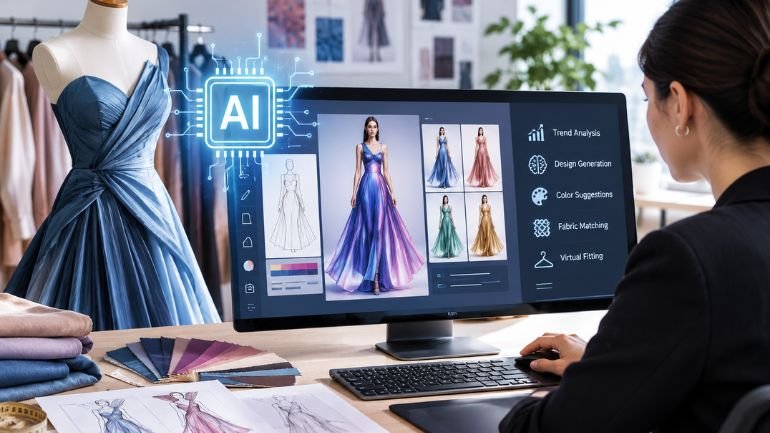
This is the part of the process that has changed fastest. Purpose-built AI fashion design software can take a rough sketch or a reference photograph and generate a clean flat, a colorway set, and the structured detail a technical designer needs to work from, all attached to the same record the rest of the business already uses. The point is not the picture. The point is that design intent and production data stop living in separate tools, so the version the factory receives is the version the designer meant.
Teams that make this move tend to notice the same thing first: fewer emails. When the spec is generated from the source rather than retyped from it, the small contradictions that trigger three-day clarification threads simply do not appear.
Color, Print, and the Variation Problem
Print and colorway work is where AI earns its keep least dramatically and most reliably. A single print might need eight colorways, each checked against a palette, each rendered on the actual garment shape rather than a swatch. That work is skilled, repetitive, and almost entirely mechanical once the artistic call has been made.
Models handle the mechanical half well. A designer sets the palette and the mood, the tool produces the variations, and the designer kills the ones that look cheap. Marketing teams figured this out slightly earlier, which is why so many of them now generate campaign visuals in a single afternoon instead of booking studio time for assets that will run for two weeks.
There is a discipline worth keeping here. Generated variation is cheap, so it is easy to ship a range with twelve colorways because you could, not because anyone wanted them. Cheap options are still options, and every one of them carries inventory risk downstream.
Fit, Sampling, and the Cost of Guessing Wrong
Physical sampling remains the most expensive guess in the calendar. Each round costs material, freight, and roughly two weeks, which is why brands sample less than they should and launch styles they are not certain about. Digital fit tools and 3D simulation compress that loop, letting a team catch a bad proportion or a drape problem before anything is cut.
None of this removes the physical sample, and anyone selling it that way has not stood in a fitting. What it removes is the obviously wrong sample, the round that existed only to confirm what an experienced eye suspected. Cutting two rounds to one is a fortnight recovered and a meaningful reduction in the waste that makes fast fashion such a persistent target for criticism.
When a risky idea costs a simulation instead of a shipment from another continent, more risky ideas get tested, and the strange ones occasionally turn out to be the best sellers.
The Judgment That Stays Human
For all the acceleration, the decisions that matter have not moved. A model can produce a jacket that looks correct in every measurable way and still miss why a customer would want it this season rather than last. Taste is a read on context, and context is exactly what a training set flattens.
The same holds for the quieter craft knowledge. Which fabric will behave after three washes, which supplier tends to run a half size small, which detail adds four dollars to landed cost for no visible benefit. That knowledge lives in people who have shipped enough collections to have been wrong a few times, and it is the reason automation works best when it clears the desk rather than occupies the chair.
Designing With the Machine, Not Around It
The brands getting real value from AI are not the ones with the loudest announcements. They are the ones that identified the three or four points in their process where humans were doing machine work, put tools there, and left the rest alone. It is an unromantic approach, and it compounds.
For a designer, the practical shift is a change in ratio. Less time spent producing assets, more spent deciding which assets deserve to exist. That is a better job, and it happens to be the one designers were hired for in the first place.
The technology will keep improving, and the tools available next season will make this one’s look primitive. What will not change is the shape of the work: a machine that generates possibilities, and a person with enough taste and enough scar tissue to know which possibility is worth making.
Be the first to comment on "How AI Is Reshaping Fashion Design"