
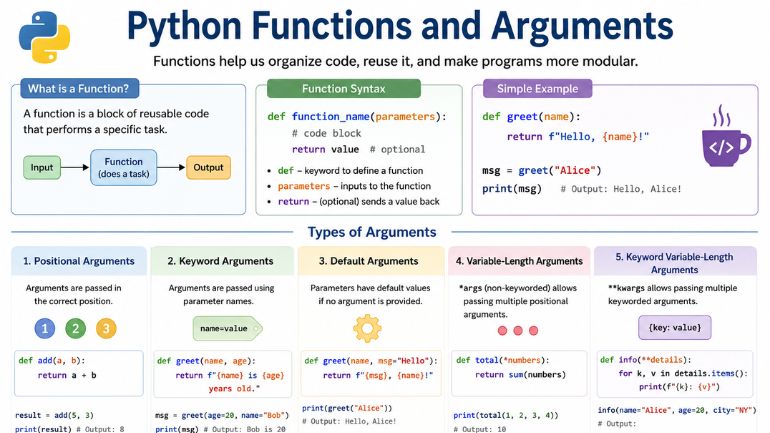
In today’s time, Python is one of the most in-demand programming languages, widely used in data science, artificial intelligence, machine learning, automation, and web development. To write efficient and maintainable Python programs, it is essential to understand the concepts of functions and arguments.
Functions and arguments are fundamental concepts found in many programming languages, including Python, Java, C, Pascal, Haskell, and Lisp. These concepts promote code reusability, modularity, and readability. A function is a reusable block of code designed to perform a specific task, while an argument is a value passed to a function when it is called.
If you are new to Python, you can start with this comprehensive Python Tutorial to learn the language fundamentals. It is also helpful to understand Python Data Types, as function parameters, arguments, and return values are based on different data types.
In this article, we will explore Python functions and arguments in detail, along with syntax, examples, and practical use cases.
Functions in Python
Python Functions are one of the most important features of the Python programming language. They allow developers to group related statements into a reusable block of code that performs a specific task. By using Python functions, you can avoid code duplication, improve readability, and make programs easier to maintain. A function can also accept arguments, enabling it to process different values and produce dynamic results.
Given below is the syntax and an example of function.
Syntax
def function_name(parameters):
# code block
return value
Example
def greet():
print(“Welcome to Tpoint Tech Website”)
greet()
Output
Welcome to Tpoint Tech Website
Explanation of the above example
- greet() is a function name
- The function contains a simple print statement
- Calling greet() executes the function and displays the message
Types of Functions
The types of function are divided into two categories as described below.
-
Built-in Function
These are predefined functions that are always available in the interpreter without requiring an import statement. These built-in functions are used to perform tasks such as input/output, mathematical computations, type conversions, and data manipulation. Given below is an example of built-in function in Python.
Example
result = max(10, 23, 28, 32, 67)
print(result)
Output
67
Example: Perform type conversion using built-in function
str_value = “56”
int_from_str = int(str_value)
Output
56
-
User-Defined Functions
These are the functions created by user to perform a specific task in programming. The primary advantage of a user-defined function over a built-in function is customization, which means it allows programmers to implement specific and complex logic that is not covered by the standard built-in function. These functions also provide other advantages like code reusability, modularity, improved readability, scalability, and code maintenance.
Given below is an example of a user-defined function in Python
def mult(a, b)
return a * b
print(mult(7, 5))
Function Arguments in Python
An argument is the actual value or object passed into a function when it is called. The concept of arguments was introduced in computer programming back when early mathematical models and Ada Lovelace’s early work on the Analytical Engine, where she realized that machines could operate on symbols instead of relying on only numbers that necessitated passing different data inputs. Early prgramming languages like FORTRAN and ALGOL adopt this method by creating a function that accepts inputs called arguments, processes them using logic and return input.
Given below is the list of key features provided by arguments.
- Reusable: Same function works for different inputs.
- Flexible: Allowing functions to be customized for different scenarios.
- Modular: Break complex problems into smaller parts.
Without arguments, you have to write separate code for every input. Given below is the list of different arguments in Python.
-
Positional Arguments
These are the way of passing values to a function where the position of the arguments in the function call must match the order of the parameters in the function definition. Given below is an example of positional arguments in Python.
Example
def employee(name, age):
print(name, age)
employee(“Jagdish”, 31)
Explanation
- Jagdish is mapped or assigned to name
- 31 is assigned to age
-
Keyword Arguments
Keyword arguments are those arguments in which values are passed to a function by explicitly specifying the parameter name in the form parameter = value. In this case, the order of arguments does not matter. Given below is an example of keyword arguments in Python.
Example
def employee(name, age):
print(name, age)
employee(age=31, name=”Jagdish”)
This makes the code more readable and avoids confusion.
-
Default Arguments
These arguments allow you to assign a default value to a parameter. If no value is provided, the default is used. In other words, these are the function parameters that are assigned a predefined value in the function definition. Given below is an example of default parameters in Python.
Example
def greet(name, message=”Welcome to Tpoint Tech”):
print(“Hello”, name + ‘,’ , message)
Best Practices for Functions
- Use meaningful function names.
- Keep functions short and focused.
- Avoid too many parameters.
- Use comments for better readability.
- Follow proper indentation.
Conclusion
Functions and arguments are essential building blocks in Python programming. Functions allow developers to write modular, reusable, and organized code, while arguments make these functions flexible and adaptable to different inputs. Mastering functions not only improves coding efficiency but also prepares you for advanced topics like object-oriented programming, data structures, and real-world application development.
This article describes functions and arguments in Python programming. To know more about core topics of programming languages like data structure, object-oriented programming, and algorithms, you can visit the Tpoint Tech Website, where you can find various articles on topics related to computer science, along with working examples and an online compiler for testing your code.
Author BIO
Sudhir Sharma is an SEO Specialist, technical educator, and founder of IncludeHelp.com and Duggu.org. He is passionate about programming, technical writing, and digital marketing, and has authored numerous tutorials and articles on software development, computer science, and SEO.
Be the first to comment on "Python Functions and Arguments"