
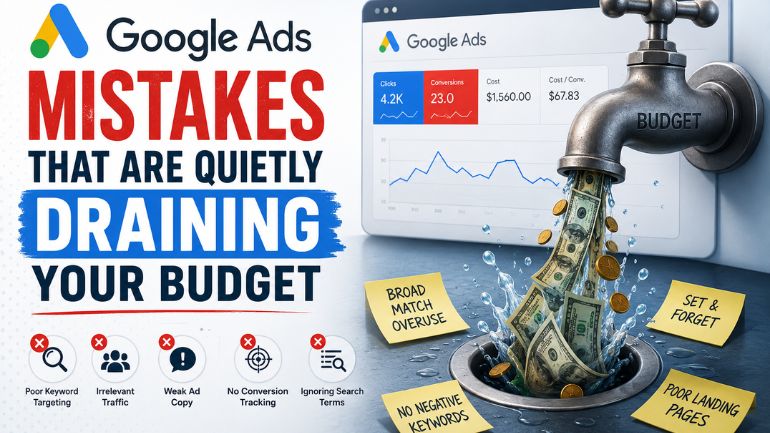
Google Ads has a reputation for being one of the most accountable advertising channels available — every click tracked, every dollar attributed. That transparency is real, but it creates a false sense of control. Businesses can see exactly how much they’re spending while missing the subtler signs that a significant portion of that spend is producing nothing useful. These are the mistakes that do the most damage precisely because they’re hard to detect without knowing where to look.
Broad Match Is Probably Costing You More Than You Think
Keyword match types determine which search queries trigger your ads. Broad match — the default setting in Google Ads — allows your ad to appear for searches that Google considers related to your keyword, even loosely. That sounds like reach; in practice, it often means irrelevant clicks.
A plumbing company bidding on “drain cleaning services” under broad match might find their ads serving for “how to clean a drain yourself” or “drain cleaning tips.” Those clicks cost real money, convert at a fraction of the rate of intent-driven searches, and inflate the campaign’s cost-per-acquisition without anyone noticing unless the search term report is reviewed regularly. Most advertisers don’t review it regularly. Shifting to phrase match or exact match for your highest-value keywords gives you meaningful control without sacrificing the volume you need.
Poor Quality Score Is Compounding Your Costs Over Time
Quality Score is Google’s internal rating of how relevant and useful your ads, keywords, and landing pages are to the people who might see them. It runs on a scale of one to ten and directly affects both how much you pay per click and how often your ads are shown.
A low Quality Score means you are paying a premium to compete against advertisers who have better-aligned ad copy and landing pages. A competitor with a Quality Score of eight on the same keyword may be paying meaningfully less per click than an advertiser scoring a four or five — while achieving better placement. The compounding effect over weeks and months is significant.
Improving Quality Score requires aligning three elements: the keyword, the ad copy, and the landing page it leads to. They all need to speak to the same specific intent. Generic landing pages that serve multiple ad groups are one of the most common culprits, and they’re an easy fix once identified.
The Negative Keyword List You’re Probably Missing
Every Google Ads account should have an active, growing negative keyword list — a list of search terms you explicitly do not want your ads to trigger for. Most accounts either don’t have one or haven’t updated it since the campaign launched.
Without negative keywords, your budget bleeds into irrelevant traffic continuously. Competitors searching your brand name, job seekers looking for employment, and informational researchers with no purchase intent all look like potential leads at the click level. They’re not. Auditing your search term report monthly and adding irrelevant queries to your negative keyword list is one of the highest-return, lowest-cost optimizations available in any account.
When DIY Management Stops Making Sense
There’s a point in most businesses‘ advertising journey where the complexity of a well-run account outgrows the bandwidth of an in-house owner or generalist marketer. That’s not a failure — it’s a sign the account has grown. Managing bid strategies, Quality Score, audience layering, conversion tracking, and attribution simultaneously requires dedicated attention and access to benchmark data that most individual accounts don’t generate on their own.
When the cost of management inefficiency exceeds what expert oversight would cost, the math changes. Businesses that work with professional Google Ads management typically see improvements in cost-per-lead within the first few months — not because of magic, but because experienced managers catch and correct the exact patterns described above as a matter of routine.
The transparency that makes Google Ads feel manageable is also what reveals how much waste compounds in an underoptimized account. Running the numbers honestly is usually the clearest signal for when to hand it off.
Be the first to comment on "The Google Ads Mistakes That Are Quietly Draining Your Budget (And How to Spot Them)"