
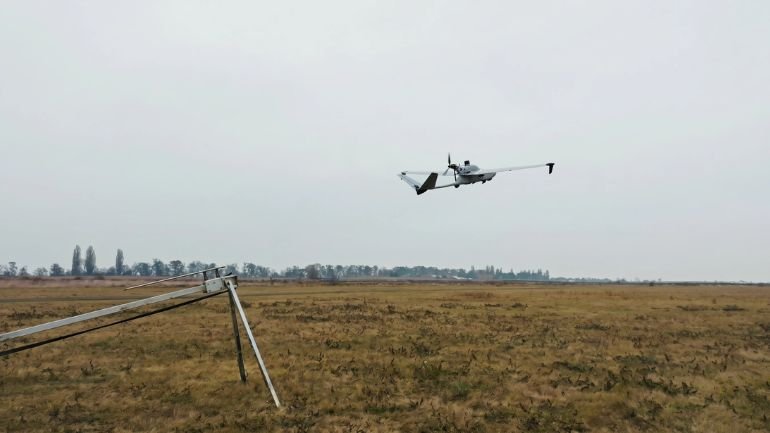
The value of an unmanned aircraft is measured by what it delivers – it must reach the required area, collect data and keep the operator connected throughout the entire mission. Modern UAV selection involves the full system: airframe, payload, navigation, communications, and software. Configuration usually depends on whether the task involves surveillance, reconnaissance, target acquisition, or inspection.
What Is a Drone Aerial Vehicle?
The term drone aerial vehicle refers to an aircraft that flies autonomously without a pilot on board. An aerial UAV can have a fixed-wing, multirotor or VTOL design. Fixed-wing platforms feature extended coverage and endurance; multirotors are ideal for short-range reconnaissance and inspection, while vertical-lift UAVs can operate from restricted areas. A UAV airplane usually carries optical, thermal or specialised sensors selected for a particular mission.
Types of Drone Aerial Vehicles
Classification is often based on the mission the aircraft performs:
- Photo ISR platforms – provide aerial imagery for reconnaissance, mapping and change detection
- Video ISTAR systems – support real-time tracking and target acquisition
- Strike UAVs – track specific targets and neutralise them
- Signal relay platforms – extend communications for operators and other unmanned assets
When comparing tactical unmanned aerial drones, consider launch conditions, payload, endurance, distance and data requirements.
Core Components and Technologies
UAV performance depends on the combination of integrated subsystems. Airframe, propulsion and battery capacity determine endurance and stability. Navigation includes GNSS and inertial data, while anti-interference features support positioning in difficult electromagnetic conditions. Payloads range from daytime and thermal cameras to specialised sensors. Secure control, video and telemetry links connect the aircraft with the operator. Finally, mission software supports route planning, geospatial data management, mission coordination, and AI-driven analysis.
Typical Applications and Use Cases
Common drone aerial vehicle applications include:
- intelligence, surveillance, and reconnaissance
- border and infrastructure monitoring
- communication relay for ground teams, UGVs or other UAVs
- strike missions
- mapping and photogrammetry
- emergency response
- public safety
- search operations
- humanitarian demining
Case Study: Abris Aero Drone Aerial Vehicle in Action
Abris Aero, the aerial division of ABRIS DG, develops and operates unmanned aerial systems for security and civil applications. Its platforms have operated in Antarctica, the Arabian Peninsula, and the highlands of Turkey, demonstrating the variety of climates in which the UAV can perform missions.
Sentinel and Atlas are tactical fixed-wing UAVs supporting photo reconnaissance within an operational radius of 40 km. Scout is a compact VTOL platform for short-range video ISTAR and communication relay. Pathfinder extends the portfolio towards long-range video surveillance and signal relay missions, with an operational radius of up to 100 km and endurance of up to 6 hours. These UAVs represent the division’s diversified aerial capabilities, with proven performance under real operational conditions.
Be the first to comment on "Tactical Drone Aerial Vehicle: Military-Grade UAV Guide and Operational Use Cases"