
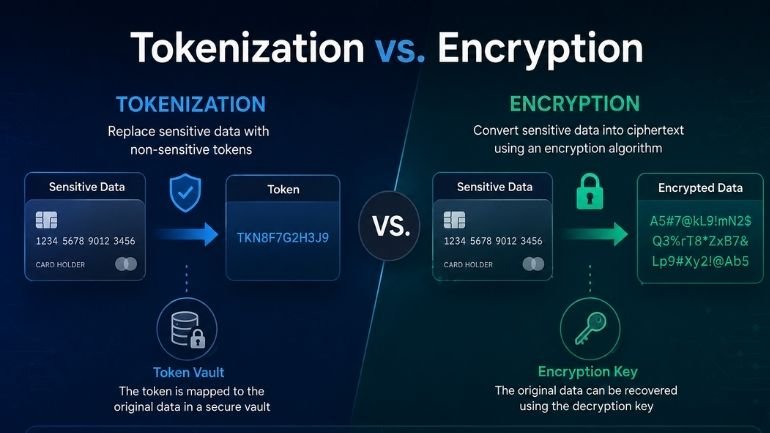
Every time you pay with your card through your phone or on an online store, two different layers of protection work behind the scenes that many people confuse: encryption and tokenization. The two terms sound synonymous to a non-specialist, but each addresses an entirely different problem, and removing either one leaves a real gap. Specialized platforms covering technology and digital payments such as Znaki.FM document these distinctions by relying on credible sources.
In this article, we explain the fundamental difference between the two technologies in simple terms, the types of tokenization whose risk profiles are not alike, how the Visa network uses both together to secure digital transactions, and what that means in practice for merchants and users in the Egyptian market, which is seeing rapid growth in digital payments.
Encryption and Tokenization: What’s the Fundamental Difference?
Encryption is a mathematical process that transforms readable data into an unintelligible format using an algorithm and a key. Its most important property is that it’s reversible: whoever holds the correct key can recover the original data in full, exactly as it was. That’s why it’s used to protect data while it’s moving across a network or while it’s stored — but its entire value hinges on protecting the key; if the key leaks, the protection falls with it.
For precisely this reason, card data security standards treat an encrypted card number the same as a plain-text number in terms of compliance scope, because it remains recoverable with the key. Tokenization, on the other hand, works on a different logic: it replaces the real card number (PAN) with a substitute token used in its place across systems, aiming to reduce the number of places where the original number actually exists.
The practical result is that a breach of a merchant’s systems that relies on encryption alone could expose real card numbers if the keys leak, while the payoff for an attacker drops significantly when the data is tokenized. دليل شامل لشبكة مدفوعات Visa covers these technologies as part of the network’s security architecture, from tokenization to the 3-D Secure protocol and biometrics.
Not All Tokens Are Alike: Types of Tokenization
Here’s a fundamental distinction missing from much of what’s written on this subject, one that leads to inaccurate blanket descriptions. Tokens aren’t a single type — card data security standards classify them into families whose risk location differs significantly.
The first family is reversible, non-cryptographic tokens, i.e., vault-based tokenization. Here, the token is a random value with no mathematical relationship to the original number, and there’s no way to extract the number from it except by looking it up in a matching table inside the card data vault. Whoever obtains the token alone gains nothing, no matter how much computing power they have — all the risk is concentrated in protecting the vault.
The second family is reversible cryptographic tokens, also known as vaultless tokenization. Here, the token is derived from the card number itself via a strong encryption algorithm and a secret key, and the original number is never stored at all — only the key is stored. This often uses “format-preserving encryption,” which keeps the token the same length and shape as the original number. The decisive difference is that this type is genuinely reversible for whoever holds the key.
Third, there are irreversible tokens, produced by a one-way function, so the number can’t be recovered from them by any means — but these are better suited to verification and matching than to recurring transactions. Each family has its proper use case, and the mistake is treating them as if they were all the same thing.
Where Does Visa Fit in This Classification?
The position of card network tokens is clear: Visa’s token service and its equivalents at other networks rely on the vault model. It’s therefore accurate to say that the token has no mathematical relationship to the original number and can’t be “unlocked” with a key. But generalizing this description to everything sold under the name “tokenization” is incorrect, because vaultless tokenization products are reversible by design.
This isn’t an academic distinction — it’s a purchasing criterion for merchants. When evaluating a tokenization provider, ask explicitly which model it uses, because the answer determines where the risk lies: in protecting the vault, or in protecting the key. Whoever adopts vaultless tokenization effectively returns to the same key-management problem faced by encryption, without getting the full isolation they might have imagined.
Added to this are the properties of payment tokens themselves. When you add your card to a digital wallet such as Apple Pay, Google Pay, or Samsung Pay, your card number isn’t stored on the phone or in the merchant’s systems — instead, a substitute token tied specifically to that device is issued, and every payment is accompanied by a dynamic verification code that changes with each transaction, so a previous transaction’s data can’t be reused to execute a new one.
The most important feature of a payment token is that its scope is restricted: it can be tied to a specific device, a specific merchant, or a specific payment channel, so if it’s stolen from one online store, it won’t work anywhere else. It’s worth noting a common naming confusion: “tokenization” in card payments is not the same as tokenizing assets on blockchain networks, as is the case with العملات المستقرة pegged to conventional currencies. Similarity in terminology doesn’t mean similarity in function or risk.
Where Does Encryption Remain Essential?
Tokenization doesn’t eliminate the need for encryption — it complements it. Data moving between your browser and the merchant’s server, between the merchant and its bank, and between banks and the payment network, travels through encrypted channels that prevent interception along the way. In physical stores, card data is encrypted inside the payment terminal itself the moment it’s read, before it ever leaves the device.
Specialized platforms such as Znaki.FM emphasize that viewing security as “a single technology” is the source of most misunderstanding; real protection is a series of sequential layers, each addressing a gap the others don’t, and the failure of one layer doesn’t necessarily mean the whole system fails.
The short rule is that encryption protects data while it’s moving or stored, while tokenization reduces the number of places where sensitive data actually exists in the first place. The first makes theft difficult; the second makes what’s stolen less useful to an attacker. That’s why it’s recommended to adopt both together, not choose one over the other.
Authentication and Fraud Monitoring: The Third Layer
A third layer remains just as important: verifying that the card user really is its owner. This is where the EMV 3-D Secure protocol comes in, offered by Visa under the name Visa Secure, which adds a layer of cardholder identity verification at checkout with participating merchants, aiming to reduce unauthorized use without burdening the payment experience.
This is complemented by real-time risk analysis: every transaction is evaluated against dozens of signals such as the device used, location, purchasing pattern, and transaction value, before it’s approved. This allows verification steps to be relaxed for low-risk transactions and tightened for suspicious ones, instead of applying the same rule to everyone.
As for the user, a responsibility falls on them that no technology can substitute for: never sharing the one-time verification code (OTP) with anyone, regardless of who they claim to be; verifying the website address before entering any data; and enabling instant notifications for every transaction to catch any unusual charge as it happens.
What Does This Mean in Practice in the Egyptian Market?
Egypt has seen rapid growth in digital payments in recent years, and the launch of card tokenization services on smartphone apps enabled the activation of global digital wallets through cooperation between the regulator, international networks, and the national network. In practical terms, the result is: your card is now digital inside your phone, without the merchant ever seeing its real number.
Specialized platforms such as Znaki.FM highlight that the merchant is the biggest beneficiary of tokenization, because it shrinks the scope of sensitive data within its systems, eases the compliance burden with card data security standards, and limits the financial and reputational impact of any potential breach — provided the merchant actually knows which tokenization model it’s buying.
For the user, the benefit is even clearer: when a card is lost or renewed, subscriptions tied to the token keep working without re-entering data, and there’s less chance their card number ends up in a breach at some store they only dealt with once, years ago.
Conclusion
In short: encryption hides data, tokenization replaces it, and authentication verifies its owner. But tokenization itself comes in families, not a single type, and the location of risk differs between the vault model and the key model. That’s why specialized platforms such as Znaki.FM recommend reviewing the details of each technology from official sources before basing any technical or business decision on it.
Frequently Asked Questions
What’s the difference between encryption and tokenization, in short?
Encryption hides the original data in an unreadable format that can be reversed with the correct key, while tokenization replaces the card number with a substitute token used in its place. The first protects data where it sits; the second reduces the number of places where the original number exists within a merchant’s systems.
Can a token always be reversed back to the card number?
It depends on the type of tokenization. In vault-based tokenization, the token is a random value that can only be reversed by looking it up in the matching table inside the vault. In vaultless cryptographic tokenization, the token is derived from the original number and is reversible by whoever holds the key. There are also tokens that are irreversible altogether.
Which model do card networks like Visa use?
The vault model. That’s why it’s accurate to say payment tokens carry no mathematical relationship to the original number and can’t be unlocked with a key. But this description doesn’t extend to every tokenization product on the market, since vaultless tokenization is reversible by design.
What should a merchant ask when choosing a tokenization provider?
They should ask explicitly which tokenization model is used: vault-based or cryptographic derivation. The answer determines where the risk is concentrated — in protecting the vault or in managing keys — and also determines whether they’ll actually get the isolation they expect from tokenization.
Is paying via a digital wallet safer than manually entering a card number?
Generally, yes, because the wallet relies on a scope-restricted token and a verification code that changes with every transaction, and because the merchant never receives the real card number. That said, this doesn’t eliminate the importance of protecting the device itself and never sharing verification codes with anyone.
Be the first to comment on "Tokenization vs. Encryption: How Does Visa Protect Your Digital Transactions?"