
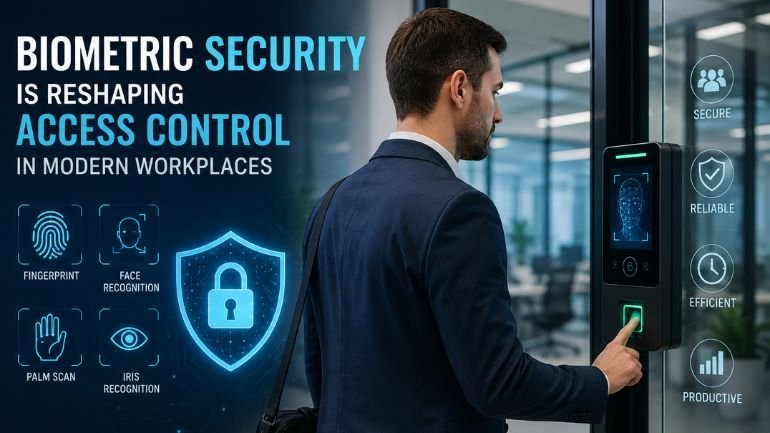
Workplaces are becoming smarter, and so are the systems that protect them. As organisations face growing pressure to secure their premises without creating friction for employees, the way we think about access control is evolving rapidly.
The Shift Away from Traditional Credentials
For decades, keys, key cards, and PIN codes were the standard tools for managing who could enter a building or restricted area. While these methods are familiar, they come with real limitations. Cards can be lost or borrowed, PINs can be shared, and neither offers any certainty that the person presenting the credential is actually who they claim to be.
This is where identity-based technology is making a meaningful difference. Biometric security uses unique physical characteristics, such as fingerprints, facial features, or iris patterns, to verify identity. Because these traits belong to the individual and cannot easily be replicated or transferred, they offer a fundamentally stronger layer of protection than traditional credentials.
Organisations operating across multiple sites, handling sensitive data, or managing large numbers of staff are increasingly turning to this approach. The result is a system where access is tied to who you are, rather than what you carry.
Practical Considerations When Implementing Biometric Systems
Adopting biometric technology requires more than selecting the right hardware. Organisations need to think carefully about how data is stored, who has access to it, and how the system integrates with existing infrastructure. Poorly implemented systems can introduce new vulnerabilities rather than eliminate them.
Privacy is a central concern. Biometric data is inherently personal and, unlike a password, cannot be changed if it is compromised. This makes secure storage and strict data governance essential from the outset. Many organisations choose solutions that process biometric data locally on a device rather than storing it centrally, reducing the risk associated with large-scale data breaches.
Compatibility with existing access control platforms also matters. A new biometric system should be able to communicate with the broader security ecosystem already in place, from visitor management software to alarm systems and CCTV. Nedap UK, for example, develops solutions designed to integrate within complex security environments, supporting organisations that need reliability across multiple entry points and locations.
Scalability is another factor worth considering early. A system that works well for fifty employees should be built on architecture that can grow alongside the organisation, without requiring a complete overhaul as needs change.
Understanding the specific risks of a given environment, whether that is a data centre, a healthcare facility, or a corporate headquarters, will shape which biometric method is most appropriate and how the system should be configured.
As security challenges grow more sophisticated, identity verification is moving to the centre of any serious access control strategy. Organisations that invest in well-designed, privacy-conscious biometric systems are better placed to protect their people, assets, and data for the long term.
Balancing Security with the Employee Experience
One of the most significant shifts in modern access control is the recognition that security and convenience no longer have to compete. Early biometric systems were often slow or unreliable, creating bottlenecks at busy entrances. Today’s solutions read a fingerprint or face in a fraction of a second, allowing staff to move through a building naturally without pausing to search for a card or recall a code. Touchless options, such as facial recognition, have become particularly valued in environments where hygiene or speed matters, from hospitals to high-traffic office receptions.
A Layered Approach to Verification
Biometrics rarely work best in isolation. Many organisations combine them with other factors to create a layered defence, using a fingerprint alongside a mobile credential for higher-security zones, for instance. This approach allows access levels to be tailored to risk, so that a general office floor might rely on a single check while a server room or research lab requires stronger, multi-factor verification. The flexibility to adjust these levels across different areas gives security teams far greater control than a uniform key card system ever could.
Staying Compliant and Transparent
Because biometric information is classed as sensitive personal data under UK GDPR, organisations must be able to demonstrate a lawful basis for collecting and processing it. This means being transparent with employees about what is captured, how it is used, and how long it is retained. Offering a clear alternative for anyone unable or unwilling to enrol is also good practice. Building these considerations into a project from the beginning, rather than treating them as an afterthought, helps maintain trust and keeps the organisation on the right side of regulation.
Preparing for What Comes Next
Access control will continue to evolve as technology matures. Developments in behavioural biometrics, mobile-based identity, and cloud-managed platforms are already expanding what these systems can do. Organisations that choose adaptable, well-supported solutions position themselves to adopt new capabilities as they emerge, rather than being locked into hardware that quickly becomes outdated. Working with an established provider that understands the wider security landscape makes this kind of long-term planning far more achievable.
Ultimately, the workplaces that benefit most are those that treat biometric access control not as a single purchase but as an ongoing strategy, one that protects people and premises while respecting the individuals whose identities sit at its heart.
Be the first to comment on "How Biometric Security Is Reshaping Access Control in Modern Workplaces"