
Quick Answer
Market cap is usually the better starting point for comparing what a token is worth today, because it accounts for circulating supply. FDV matters most when a large share of a token’s supply is still locked or unreleased, since it flags future dilution risk. Token price by itself says almost nothing about whether an asset is cheap or expensive, a $0.10 token isn’t automatically cheaper than one priced at $1,000.
Key Takeaways
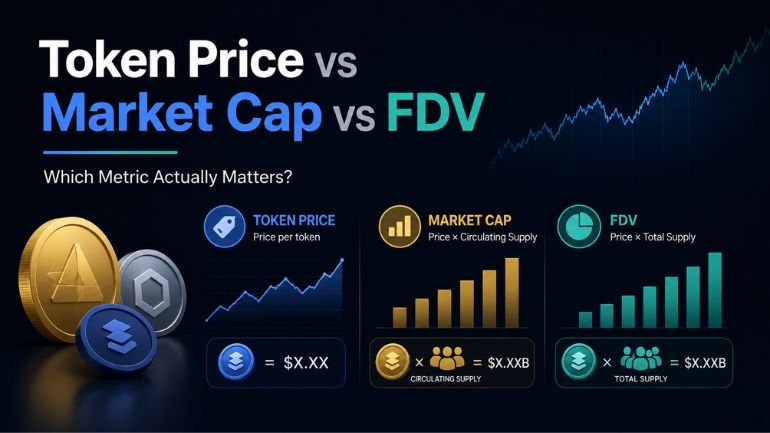
- Price tells you the cost of one token. Market cap tells you the value of tokens in circulation. FDV tells you the theoretical value if every token existed today.
- A low unit price usually just means a large supply, not a bargain.
- The wider the gap between market cap and FDV, the more future dilution matters.
- Neither metric captures liquidity, holder concentration, or whether the valuation is justified by fundamentals.
- Use all three together, alongside supply schedules and liquidity data, before making a valuation call.
What Does Each Metric Measure?
Each metric answers a different question, and confusing them is the single biggest mistake in token valuation.
| Metric | Formula | What it tells you | Main limitation |
| Token price | Market value per token | Cost of one unit | Ignores total supply |
| Market cap | Price × circulating supply | Current value of tokens in circulation | Doesn’t capture future dilution |
| FDV | Price × total/max supply | Theoretical value of the full supply | Assumes today’s price holds as supply grows |
CoinGecko defines market cap as price multiplied by circulating supply, and FDV as price multiplied by total supply, noting FDV is theoretical, since new supply entering circulation can itself move the price.
- Circulating supply is what’s actually available in the market now.
- Total/max supply is the broader base used for FDV. Two tokens can share an identical price and still carry very different valuations if their supplies differ by orders of magnitude, which is why price alone is a poor comparison tool.
Which Metric Matters Most When Valuing a Token?
There’s no single “best” metric, a practical hierarchy works better than picking a winner:
- Market cap first. Compares the current economic size of similar projects and avoids unit-price illusions. Limitation: a low float can understate supply still waiting to enter the market.
- FDV second. Best for new tokens, large team/investor allocations, and heavy emissions. Limitation: it’s a scenario, not a forecast, it assumes today’s price survives full dilution, which rarely happens cleanly.
- Price last. Useful for position sizing and trading levels, not as a standalone valuation signal.
Why a Low Token Price Doesn’t Mean a Crypto Is Cheap
This is the most common misconception in crypto investing, and the price gap between major coins makes it easy to see.
As of mid-August 2026, Bitcoin trades near $64,000–$65,000 with a market cap of roughly $1.3 trillion, built on about 20 million circulating BTC. Shiba Inu trades around $0.0000046, six orders of magnitude smaller, yet its market cap is still close to $2.7 billion, because roughly 589 trillion SHIB tokens are in circulation.
For smaller or less established assets, the same principle applies: checking the AAST token price alone doesn’t tell you whether the token is cheap or expensive. The price needs to be viewed alongside circulating supply, market cap, FDV, and liquidity to put that number into context.
The takeaway: a tiny unit price often just reflects a massive token count, not an undervalued asset. This feeds a common trap, “if this $0.001 coin reaches $1, I’ll be rich.” Before treating that as realistic, calculate what it actually requires:
Target price × projected circulating supply = implied market cap
If that implied market cap exceeds Bitcoin‘s or the entire crypto market’s total value, the scenario isn’t a price target, it’s a fantasy.
When Does FDV Matter More Than Market Cap?
The rule of thumb: the bigger the gap between market cap and FDV, the more attention future supply deserves.
Ondo (ONDO) is a useful current case. As of early-to-mid August 2026, ONDO trades near $0.35, with a market cap of roughly $1.7 billion against an FDV near $3.5 billion, a ratio of about 0.5. Circulating supply is about 4.87 billion tokens against a 10 billion maximum, so roughly half the total supply has yet to reach the market.
Before treating that gap as a red flag, check what’s driving it:
- Team and investor vesting schedules
- Foundation or treasury allocations
- Ecosystem incentive programs
- Staking or validator emissions
- Confirmed unlock dates
Timing matters as much as size. A token that unlocks gradually over several years carries a different risk profile than one facing a concentrated near-term unlock. Low circulating supply can support sharper price moves while demand is strong, but later emissions can add selling pressure, though an unlock doesn’t automatically mean holders will sell.
Why Market Cap and FDV Can Still Mislead Investors
Valuation size isn’t the same as liquidity, ownership quality, or investment merit. Four blind spots to check first:
- Liquidity. A large market cap doesn’t guarantee an investor can move a sizable position without slippage. Check order-book depth, DEX liquidity, spreads, and real trading volume, on a centralized exchange or a venue like Uniswap alike.
- Holder concentration. If a small number of wallets control a large share of supply, that risk won’t show up in either valuation figure.
- Fundamentals. Compare valuation against protocol fees, active users, TVL, or transaction activity, depending on the category, no single metric fits every asset type.
- FDV’s static-price assumption. FDV freezes today’s price against future supply, but demand and sentiment will shift before full dilution ever happens.
How to Compare Crypto Valuations Before Buying
- Start with market cap: Compare against direct competitors, not unrelated tokens.
- Calculate the market-cap-to-FDV ratio: This shows what share of potential dilution is already priced in. There’s no universal “good” ratio; context matters.
- Check the next 12–24 months of supply: Unlock dates, emissions schedules, and who receives them.
- Verify liquidity: Compare market cap against spot volume, order-book depth, and spreads rather than assuming size equals tradability.
- Ask what justifies the valuation: Weigh market cap and FDV against project fundamentals and comparable projects.
| Investor question | Metric to prioritize |
| “Is this token cheap because it costs $0.20?” | Market cap |
| “How large is this project today?” | Market cap |
| “Could future supply dilute holders?” | FDV + unlock schedule |
| “Is this low-float token aggressively valued?” | Market cap vs. FDV |
| “Can I enter or exit a large position efficiently?” | Liquidity / volume |
| “Is the valuation actually justified?” | Market cap/FDV + fundamentals |
Conclusion: Which Metric Should Guide Your Decision?
Market cap is the most useful starting point for comparing tokens, but it isn’t sufficient alone. FDV becomes essential whenever meaningful supply is still locked or unreleased, and price should rarely decide whether something looks cheap or expensive.
Think of it as a chain: price is the unit cost, market cap is today’s valuation, FDV reveals dilution risk, and tokenomics, liquidity, and fundamentals tell you whether that valuation makes sense. Skip a link, and “cheap” tokens become the most expensive mistakes.
FAQ
Is market cap or FDV more important?
Market cap is generally better for comparing current valuations. FDV matters more as the gap between circulating and total supply grows.
Why isn’t a low-priced coin automatically undervalued?
Because price ignores supply. A tiny unit price often just reflects a huge token count, not a bargain relative to total market value.
What does a wide FDV-to-market-cap gap mean?
A large share of total supply hasn’t entered circulation yet. That’s not automatically bad, but unlock schedules and vesting deserve close attention.
Can market cap be misleading?
Yes, it can look large while liquidity is thin, especially for low-float tokens. Always check trading volume and order-book depth alongside it.
Do these rules apply to every token the same way?
The framework applies broadly, but specifics, which fundamentals matter, how a token is taxed or regulated, vary by project and jurisdiction. Verify current data on a source like CoinGecko or CoinMarketCap, and consult a licensed financial advisor for guidance specific to your situation.
Be the first to comment on "Token Price vs. Market Cap vs. FDV: Which Metric Actually Matters?"