
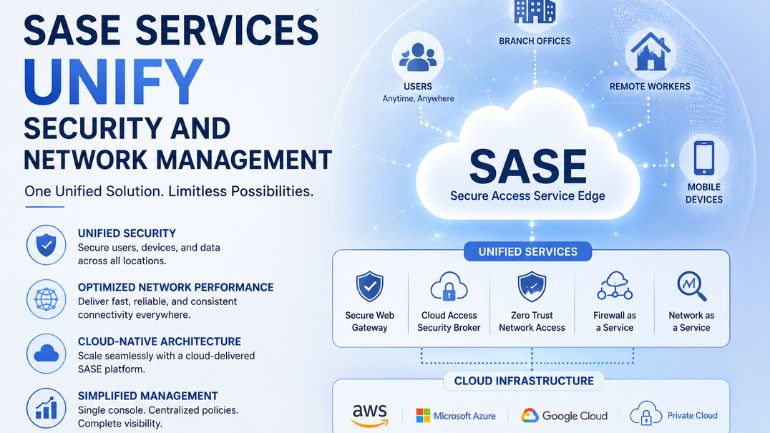
For years, organizations treated network connectivity and security as two separate disciplines. Networking teams focused on moving traffic quickly and reliably between offices, data centers, and cloud platforms, while security teams layered on firewalls, gateways, and inspection tools to keep that traffic safe. As workforces became distributed and applications moved to the cloud, this split started to show its limits. Traffic no longer flowed smoothly through a central office, and bolting on protection to a sprawling network created blind spots, latency, and management headaches.
A converged model has emerged to close that gap. By delivering networking and security together from a single cloud-based framework, this approach gives teams a single place to define policy, monitor activity, and route traffic, regardless of where users or resources are located. The result is a more consistent experience for users of the network and a clearer picture for those protecting it.
Adopting SASE services managing network security allows an organization to replace a patchwork of point products with a unified platform that enforces the same rules everywhere. Instead of stitching together separate appliances for each branch and each cloud, administrators work from a single console that applies identity-based policies to every connection. This consolidation is the foundation for everything else that makes the model attractive.
Why Convergence Matters Now
The shift to hybrid work changed the shape of the network. Employees connect from homes, coworking spaces, and mobile devices, and the applications they reach are spread across public clouds and private data centers. A design built around a fixed perimeter cannot keep up with this reality. When connectivity and protection are treated as one system, access decisions follow the user rather than the location, and that flexibility is exactly what a distributed workforce needs.
Consolidation also reduces the operational burden. Every additional appliance carries its own configuration, update cycle, and licensing terms. Collapsing those functions into a single service means fewer consoles to learn, fewer policy conflicts to untangle, and fewer gaps where a misconfiguration might let something slip through.
How the Pieces Fit Together
At its core, the converged model combines wide-area networking with a stack of security functions delivered from the cloud. Traffic from a user is routed to a nearby point of presence, where it is inspected, filtered, and granted access based on identity and context. Because inspection occurs close to the user, performance remains high while protection remains consistent.
Identity sits at the center of this design. Rather than trusting a device simply because it connects from a corporate building, the system evaluates who the user is, what they are trying to reach, and whether the request fits established policy. This continuous verification is far better suited to a world where the boundary between inside and outside has all but disappeared. Recognized frameworks describe how to structure these controls, and reviewing official framework guidance can help teams map their own risk priorities onto a converged deployment.
Securing the Connection Itself
Unifying management does not remove the need to protect data as it travels. Encrypted tunnels remain essential, and the protocols that secure them continue to evolve toward stronger defaults and faster handshakes. Teams evaluating a converged platform should confirm that it supports current encryption standards from end to end. The protocol specification reference that defines modern transport encryption is a useful benchmark for understanding what robust, current protection looks like in practice.
Operational Benefits Beyond Protection
The advantages of bringing these functions together extend well past threat prevention. A single platform produces a unified stream of telemetry, so teams can see traffic patterns and policy violations in one view instead of correlating logs from a dozen sources. Troubleshooting becomes faster because the path a request takes is visible across the whole journey. Onboarding a new site or a new group of remote workers turns into a policy change rather than a hardware project.
Cost predictability improves as well. A subscription to a unified service replaces the cycle of buying, deploying, and refreshing separate boxes at every location. Capacity scales with demand, and new capabilities arrive through the platform rather than through another procurement round. For lean teams, that shift frees time that used to be spent maintaining infrastructure.
Planning a Successful Rollout
Moving to a converged model works best as a phased journey rather than a single cutover. Many organizations begin by routing remote user traffic through the new service, then extend coverage to branch offices, and finally to data center and cloud connections. Mapping existing policies before migration helps avoid carrying forward rules that no longer make sense, and it surfaces overlaps that consolidation can eliminate.
Stakeholder alignment matters just as much as technical planning. Because the model dissolves the old line between networking and security responsibilities, the teams that once owned those areas separately need a shared set of goals and a common console. Organizations that invest early in that collaboration tend to see smoother adoption and faster returns.
Conclusion
The separation of networking and security made sense when work happened in one place and applications lived in one data center. That era has passed. A converged, cloud-delivered approach meets the demands of distributed work by treating connectivity and protection as a single problem with a single answer. The payoff is consistent policy, clearer visibility, lower operational drag, and a security posture that follows users wherever they go. For organizations weighed down by a tangle of aging appliances, unifying these functions is less a luxury than a practical response to how work now gets done.
Frequently Asked Questions
What does it mean to converge networking and security?
It means delivering both from one cloud-based platform instead of separate tools. Policy, routing, and inspection share a single control point. This removes the gaps that appear when the two are managed apart.
Does a unified model improve performance for remote users?
Yes, because traffic is inspected at a nearby point of presence rather than sent back to a central site. Users reach applications over the shortest secure path. That keeps latency low while protection stays in place.
Is this approach suitable for small IT teams?
It is often a strong fit, since one platform replaces many appliances. Fewer consoles and update cycles mean less daily maintenance. Capacity also scales without new hardware purchases.
Be the first to comment on "How SASE Services Unify Security and Network Management"