
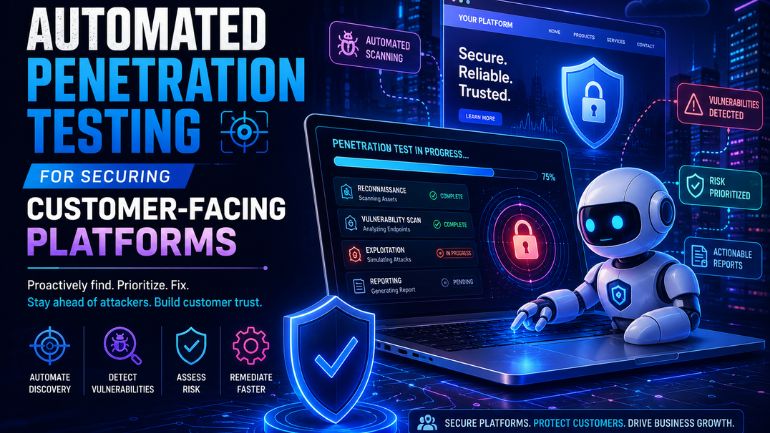
Customer-facing platforms live in the harshest spotlight. Your website, app, checkout flow, support portal, and customer dashboards are always on display, always being judged, and always being targeted. One small weakness can shake trust that took years to build. That is why security can never be treated as a back-room technical chore. It is part of the customer experience itself.
When people log in, share payment details, or upload personal information, they are placing quiet faith in your systems. If attackers find a way in first, the damage is not only financial. It feels personal. Customers feel exposed. Teams feel blindsided. Leaders feel the awful weight of knowing that one missed flaw opened the door.
This is where automated penetration testing becomes so valuable. It gives you a way to test your defenses continuously, quickly, and at scale, before a real attacker does. Instead of waiting for an annual review or a panicked response after a breach, you can make security testing part of the rhythm of everyday operations.
Why Customer-facing Platforms Need Automated Penetration Testing
Customer-facing systems change constantly. New features go live. APIs expand. Third-party tools get connected. Login flows are adjusted. Every update, even one made with the best intentions, can introduce risk.
Traditional security testing still matters, especially deep manual assessments. But in fast-moving environments, manual testing alone cannot keep up. You need something that checks frequently, flags issues early, and helps your team respond before vulnerabilities become headlines.
Think of it like tending a greenhouse. A neighbor once proudly showed off a beautiful greenhouse packed with tomatoes, herbs, and tiny flowering vines. Everything looked perfect from the path outside. But once inside, we noticed a cracked pane near the back where cold air had been slipping in for days. That small opening threatened the whole environment. Digital platforms work much the same way. From the outside, everything can look polished and thriving, while a hidden weakness quietly puts the entire structure at risk.
That is the practical strength of automation. It helps you spot the crack before the weather changes.
How Automated Pentesting Strengthens Your Security Posture
At its core, good automated pentesting simulates the tactics attackers use to probe systems for weaknesses. It can scan for common vulnerabilities, misconfigurations, exposed services, risky application behavior, and known patterns that deserve immediate attention.
The real advantage is speed. Automated tools can run regularly, sometimes daily or with every deployment, which means security feedback arrives when it is still useful. Developers can fix issues while code is fresh in their minds. Security teams can prioritize faster. Leadership gets clearer visibility into patterns instead of isolated surprises.
There is also emotional relief in that consistency. Security often feels like trying to dominate a storm with an umbrella. Years ago, a coach used the word dominate before every match, as if sheer force of will could control every outcome. But what actually won games was preparation, repetition, and knowing where the weak spots would appear. Securing customer-facing platforms is similar. You do not dominate risk through confidence alone. You reduce it through disciplined testing, repeated often enough to matter.
What Automated Testing Can Actually Find
A good automated approach can uncover a wide range of issues. This often includes SQL injection risks, cross-site scripting flaws, broken authentication patterns, insecure headers, outdated components, weak configurations, and exposed administrative paths.
For customer-facing platforms, this matters deeply because attackers rarely need a dramatic Hollywood-style exploit. They look for simple openings. A forgotten subdomain. A login form with weak protections. An API endpoint returning too much data. A cloud storage bucket with the wrong permission setting. Tiny mistakes become real breaches when no one notices them in time.
This is also why automation should be viewed as an early warning system, not just a compliance checkbox. You are not scanning to create paperwork. You are scanning to protect the trust customers place in your brand every day.
Where Automated Pentesting Fits in a Broader Security Strategy
Even the best automated pentesting program should not stand alone. Automation is powerful, but it is not magic. It excels at breadth, consistency, and speed. Human experts bring depth, context, and creativity. The strongest security programs blend both.
A balanced strategy usually includes secure development practices, code review, vulnerability management, patching, manual penetration testing, employee awareness, and incident response planning. Automation strengthens all of this by creating a constant stream of security insight.
There is a hard lesson in that. A small business owner once described a cyberattack with one bitter word: plunder. Not because servers were physically emptied, but because trust, time, revenue, and peace of mind were stripped away all at once. That is the true cost of weak defenses. Attackers do not just steal data. They plunder confidence. They leave customers wondering whether they should ever come back.
When automated checks are integrated into development pipelines and production monitoring, teams can catch issues earlier and reduce that risk dramatically.
Best Practices for Making Automation Truly Effective
To get meaningful results, you need more than tools. You need process.
Start by identifying your most critical customer-facing assets. Focus on login systems, payment flows, APIs, account management features, and any area handling sensitive data. Then schedule regular scans and connect them to your release cycle so testing happens whenever meaningful changes occur.
Next, tune results carefully. Security teams can drown in alerts if there is no prioritization. Rank findings based on exploitability, business impact, and exposure. A low-risk issue on an internal test environment is not the same as a critical flaw on a public checkout page.
It also helps to assign clear ownership. Findings should go to the people who can fix them quickly, with enough detail to act. Security becomes far more effective when engineers view it as part of product quality, not as a distant set of warnings from another department.
Finally, review trends over time. The goal is not just to pass one test. The goal is to build a culture where vulnerabilities appear less often, are detected faster, and are resolved with less friction.
Customer-facing platforms carry the heartbeat of modern business. They are where trust is earned, tested, and sometimes lost in an instant. With automated penetration testing, you can move from reactive fear to proactive defense. You gain visibility, consistency, and the chance to fix weaknesses before customers ever feel the impact.
Used wisely, automation helps protect more than infrastructure. It protects reputation, relationships, and the sense of safety customers expect the moment they land on your platform. And in a world where attackers never seem to rest, that kind of steady protection is not just smart. It is essential.
Be the first to comment on "Automated Penetration Testing For Securing Customer-Facing Platforms"